Showing posts with label Michelangelo. Show all posts
Showing posts with label Michelangelo. Show all posts
Friday, 6 May 2011

Monday, 28 March 2011
Symposium 2: Second Research: Michelangelo
The Time Machine – Symposium 2
Second Research: Michelangelo
(6 March 1475 – 18 February 1564)
First piece of work | Bacchus (1497)


Fig 1. Bacchus (1497)
"Bacchus, the Roman god of wine (known as Dionysus in Greek Mythology), was a popular subject with artists of the sixteenth century. He was usually represented with a bunch of grapes and a staff wreathed with vine leaves and ivy. Celebrations in honour of Bacchus were called Bacchanalia. In ancient times, only women were allowed to attend these festivals. Other followers of the god included the satyrs, who were half-human and half-animal. Michelangelo created a statue of Bacchus in 1497. In his work, the god of wine seems a bit unsteady on his feet. A satyr appears behind him." (Cagno, 2008:20)
"Bacchus appears to be swaying, with perhaps his right leg buckling out from under him as he potentially lurches forward. The weight of his body, which is meant in a contrapposto pose to find a centre of gravity, here shifts back and forth, with the head (and a rather comically undersized head at that!) tilted in one direction, the shoulders another, the pelvis yet another, and the legs ready to tumble out from under the staggering, inebriated god. This is a god who is standing up but is more probably about to fall down, a fact that is even structurally and formally incorporated into the entire sculptural ensemble: the wine god would, in fact, fall down if the figure were not buttressed by the presence of the little satyr behind, whose serpentine pose only emphasizes in its torsion the elements of suppressed movement contained within Bacchus himself". (Biow, 2010:111)
Second piece of work | Pietà (1498–1499)

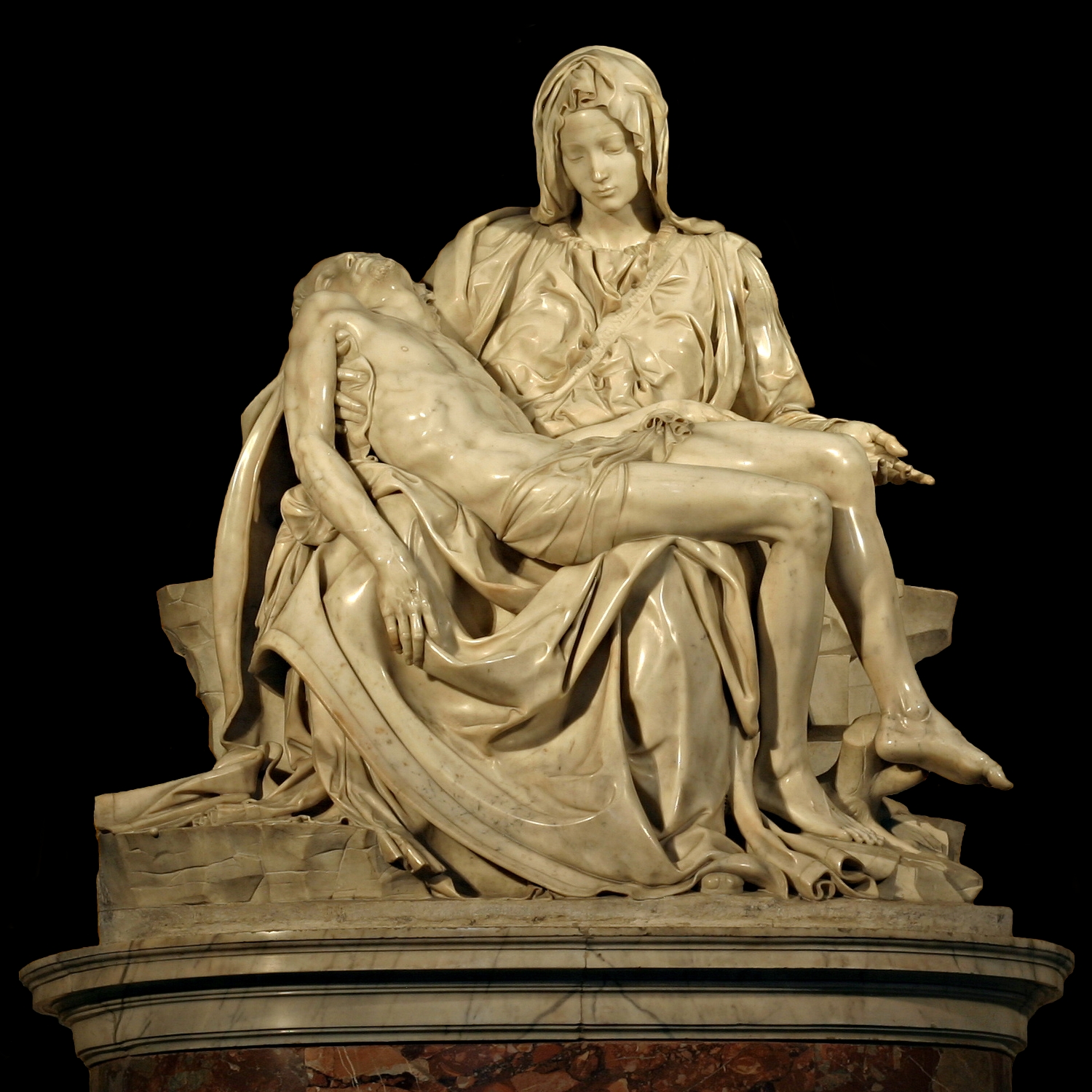
Fig 2. Pietà (1498–1499)
It is a construction that represents the Virgin Mary carrying the body of Christ on her lap. This sculpture was commissioned by the French cardinal Jean Bilhères Lagraula of which was a cardinal and ambassador to the Pope.
The human measures are not met. It is a marble statue of 174cm tall, 195cm long 69cm wide, sculpted with a chisel and hammer. The statue depicts a scene after the crucifixion of Christ. This is his only signed work. We see little besides his signature on the banner across the blank. She has a Florentine style, so a style of the Cinquecento1 as it has a taste for naturalism and interest in human and psychological truth. There are many folds on the clothes. The Virgin is seated. On her lap the dead body of Christ as an ''S''. This position is a sign of abandonment of the corpse. The sculpture forms a triangle, which symbolizes the holy trinity (father, son and holy spirit). Mary's face, is an expression of no pain, because it is home to human suffering, symbolised by Christ. She represents the Lord. His hand opened; it is an offering. This sculpture was made in one year.
Each sculpture is used as an opportunity to respond to a specific aspect. The figure of Bacchus is created in design to regard Neoplatonists influences, Michelangelo was familiar with their ideas carefully. The David (1501-1504) and its turbulent history is detailed policy regarding the role played by them in the Florence of the early 16th Century. Similarities in Bacchus and David is also found in Matthew, a dichotomy, however, first as an internal issue and detached from the outer design. Michelangelo's figures are usually not in a natural freedom, they are rebelling against the prisoner or result in their fate.
Michelangelo's Early life segment
At twenty-one years old, his imitation of The sleeping Cupid led straight to Rome. 1498, Michelangelo was only 22, before signing a contract, guaranteed by Jacopo Galli, with the French Cardinal of San Dionigi, for the plans of his next piece, Pietà, which was in construction within a year. This successful marble sculpture was destined to be placed in the The Papal Basilica of Saint Peter (Italian: Basilica Papale di San Pietro in Vaticano (in the chapel of Santa Petronilla kings of France) - a Late Renaissance church located within the Vatican City. The Pietà of Michelangelo was born from a block of marble, where the artist represents the isolated figures of the Virgin Mary holding the body of Christ in her lap just down from the cross, according to an iconography that, at that time, had found wide acceptance.
Pietà has strong anatomical details and finishes of the drapes, accentuated with translucent effects of the way the light seems to caress the marble surfaces. One of the things that is important in the sculpture is the "very young" the artist wanted to give the face of the Virgin Mary, this choice, strongly criticised by his contemporaries, is justified by the abstract nature of the composition. Between 1962 to 1964, Pieta was moved to New York World.

Fig 3. The David (1501–1504)
Footnotes______________________________________
1) Cinquecento: A term used to describe the Italian Renaissance of the sixteenth century, including the current styles of art, music, literature, and architecture.
List of Illustrations_______________________________
Fig 1. Michelangelo (1497) Bacchus [Marble] At: http://www.backtoclassics.com/images/pics/michelangelo/michelangelo_bacchus.jpg
(accessed:28.03.11)
Fig 2. Michelangelo (1498-1499) Pietà [Marble] At: http://www.arte.it/foto/orig/2f/334-Michelangelo_s_Pieta_5450_cut_out_black.jpg (accessed:28.03.11)
Fig 3. Michelangelo (1501-1504) The David [Marble] At: http://media.web.britannica.com/eb-media/87/60287-050-5124A0CE.jpg (accessed:28.03.11)

Bibliography___________________________________
G, D, Cagno. (2008) Michelangelo. (2nd ed.) USA : The Oliver Press
D, Biow. (2010) In Your Face: Professional Improprieties and the Art of Being Conspicuous in Sixteenth-Century Italy. (2nd ed.) California : Stanford University Press
Monday, 21 March 2011
Symposium 2: Chosen Practitioner: Michelangelo
The Time Machine – Symposium 2
Chosen Practitioner: Michelangelo
Deadline: The Time Machine – Symposium 2. Thursday 31st March 2011
•The focus for this Symposium is to take a practitioner in the creative arena, and treat this practitioner in a similar way to the way in which you treated the object/artefact studied for Symposium 1 – as a starting point for broad contextual investigations.
•As with Symposium 1, you will need to examine the resonances, influences and connections in association with this practitioner, both forwards and backwards in time. How was their creative work influenced by others, and by past events? What influence did they have, directly or indirectly? How can they be viewed in the light of historical and contemporary contexts?
•The direction in which the research goes can be both linear and nonlinear. You are encouraged to research at tangents as well as in straight lines! The colourful and interesting byways of Symposium 1 were one of its principal strengths.
•The practitioner can be alive or dead, historical or contemporary.
•You must not use the practioner as the main basis for your Time Machine essay, although you may refer
Auto-S.O.S/recap of the brief:
1) A clear introduction to your presentation, which should also mention the
different published sources you have used and your reasons for choice. You
should use no less than 5 published sources to inform your presentation.
2) A clear definition of key ideas relating to your given topic, with supporting
evidence in the form of, no less than, 3 quotations from 3 different published
sources. Quotations must be interpreted and their importance discussed, they
should also be referenced correctly using the Harvard method.
3) The cultural context (political and social) in which the topic came out of/was in
reaction to.
4) An illustrated ‘who’s who’ of key individuals associated with given topic, with a
clear explanation of what you think their significance is and why.
5) Historical examples of key words/images/artefacts associated with given topic
and an assessment of their importance.
6) Contemporary examples of key words/images/artefacts associated with given
topic and a comparison to the historical examples.
7) A ‘bullet point’ conclusion.
8) A bibliography and illustration list correctly set out using the Harvard method.
9) A PDF version of presentation for uploading to myUCA.
Subscribe to:
Posts (Atom)